Why Won’t My Puppy Listen to Me? How to Teach Your Puppy to Listen
Why Won’t My Puppy Listen to Me? How to Teach Your Puppy to Listen
Rowan Grebeck-Perry
“My puppy won’t listen.”
I hear this from puppy parents all the time.
But before we decide that your puppy has a listening problem, we have to ask a better question: What do you mean by “won’t listen”?
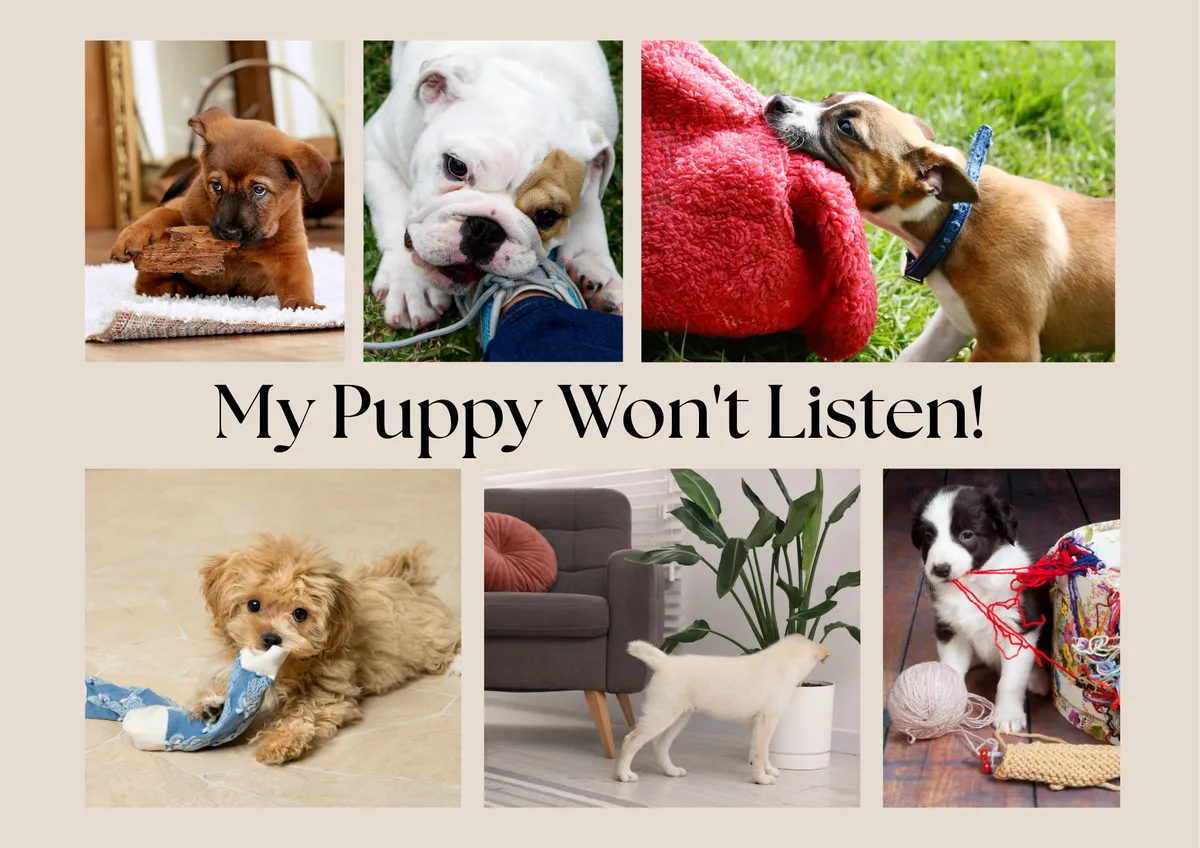
Is your puppy chewing the plant? Chasing the cat? Eating mulch in the yard? Running off when you call? Ignoring you when you say “stop”?
Those are very different problems. But there is one thing many of them have in common: your puppy has not yet learned how to listen to you when something else is competing for their attention.
And that is very different from your puppy deliberately deciding not to obey you.
I’m Rowan, and I’ve been training people and their dogs for more than eight years. I’ve helped about 2,000 families live better lives with their dogs. My goal is not simply to give you more commands to teach. I want to help you understand what is happening with your dog so you can make better decisions about what to do next.
So if you’re frustrated because your puppy seems to hear you one minute and completely ignore you the next, let’s talk about what is actually going on.
Your puppy probably isn’t trying to ignore you
Puppies are young. They are easily distracted. They are still learning how to learn, and they have very little ability to filter everything happening around them and decide, “My person is talking, so I should focus on that.”
Your puppy sees something interesting, smells something interesting, hears something interesting—and off they go.
You might be standing behind them saying, “No. Stop. Don’t do that.” Meanwhile, their brain is busy processing whatever fascinating thing they have discovered.
That doesn’t mean you should simply accept every behavior. It means you need to teach your puppy what your words mean and give them enough practice to be successful.
This is one of my default beliefs when I work with dogs: it is rarely helpful to blame the dog for not knowing something we haven’t successfully taught them yet.
That isn’t about blaming you, either. It is about giving you something useful to work on. If your puppy isn’t listening, the question becomes: What do I need to teach differently?
Stop repeating yourself and getting louder
One of the easiest traps to fall into is repeating the same command over and over.
“Come.”
“Come.”
“COME!”
Or your puppy is chewing something they shouldn’t, and you keep saying “No! No! No!” while getting more and more frustrated.
Unfortunately, frustration doesn’t teach your puppy how to listen.
When something isn’t working, you need to be calm enough to stop and ask, “What can I do that will work right here, right now?”
Maybe your puppy is too distracted. Maybe you are too far away. Maybe you haven’t practiced that skill enough. Maybe you need to manage the environment instead of expecting your puppy to make a decision they aren’t ready to make.
That change in thinking can make puppyhood much easier.
Start by teaching your puppy their name
One of the first things I want my clients to work on is teaching their puppy to look at them when they hear their name.
The exercise is simple.
Say your puppy’s name in a calm voice.
When your puppy looks at you, reward them with a small treat.
Repeat this in a calm environment until looking at you when they hear their name becomes a familiar pattern.
Gradually practice in places with more distractions as your puppy becomes successful.
The important part is that your puppy learns that their name means something. It becomes a way of getting their attention before you ask them for something else.
Think about the difference between randomly shouting “Sit!” while your puppy is busy investigating something and first saying, “Ziva,” getting her attention, and then saying, “Sit.”
If your puppy isn’t even thinking about you, you’re asking them to do a lot more than you may realize.
Use simple marker words to communicate clearly
The other foundation I use with my clients is marker words.
The basic idea is to have a simple word that tells your puppy, “Yes. That was right. I like that,” and a clear negative marker that tells them, “Stop. That choice isn’t going to work.”
When your puppy makes a good choice, mark it and reinforce it. When your puppy is making a choice that needs to stop, the negative marker needs to have meaning because you follow it with an outcome.
That outcome might simply be losing access to something. You go inside. The puppy gets off the couch. You take them away from the cat or another dog. You put them on leash because they keep getting into trouble.
The point is not to frighten your dog or punish them harshly. The point is that your puppy learns that your words predict what happens next.
I don’t teach my dogs a huge list of commands that I expect to use constantly. Clear communication through a few important words can carry you through a surprising amount of everyday life.
Your puppy has to learn what your words mean
Think about how much humans talk around dogs.
We talk on the phone. We talk to other people. We talk about the dog. We talk about dinner. We talk about what happened at work.
Your puppy hears all of it.
So you need to pull out a few specific words that actually matter to them and teach them what those words mean through repetition, timing, body language, voice, and outcomes.
That is what listening really is.
Your puppy hears a particular sound, understands that it has meaning, and knows what they are expected to do next.
You cannot skip that teaching process and then expect your puppy to magically understand you in a chaotic environment.
Practice in calm places before expecting your puppy to listen around distractions
This is another big piece of the puzzle.
If you have only practiced your puppy’s name in the quiet living room, you cannot expect the same response when they are outside, chasing something, greeting someone, or surrounded by exciting smells.
Your puppy needs successful practice before you increase the difficulty.
Start somewhere calm. Teach the skill. Reward success. Then gradually add distractions.
And if your puppy suddenly can’t do it, don’t assume they are being stubborn. You may have simply made the exercise too difficult.
Back up. Make it easier. Help your puppy succeed. Then build again.
That is how you teach listening instead of simply demanding it.
What to do when your puppy is doing something they shouldn’t
If your puppy is chewing the plant, chasing the cat, eating mulch, or getting into another situation you don’t want, try not to stand there repeating “no” while your frustration grows.
First, think about management. Could you have prevented this? Should your puppy have been on a leash? Should the environment have been arranged differently?
Then communicate clearly and follow through with an appropriate outcome.
The goal is to teach your puppy: “When I hear this word, I need to stop doing that thing—if I don't want the fun to end.”
At the same time, look for opportunities to catch your puppy making good choices. Mark those choices and reinforce them.
Your puppy needs to learn both what works and what doesn’t.
If your puppy won’t listen, ask a different question
Instead of asking, “Why won’t my puppy listen?” try asking:
Have I actually taught this skill?
Does my puppy know what this word means?
Have I practiced it in a calm environment?
Am I asking for too much with too many distractions?
Am I close enough to help my puppy succeed?
What can I change about the environment?
Am I repeating myself instead of teaching?
Those questions put you back in the driver’s seat.
Your puppy needs guidance. They need you to teach them what you expect, make it possible for them to succeed, and keep practicing as they grow.
The bottom line
A puppy who doesn’t listen is not necessarily a stubborn puppy, a bad puppy, or a puppy who doesn’t care about you.
They are a puppy.
Listening is a skill. Your job is to teach it.
Start with their name. Teach clear marker words. Reward good choices. Give your words meaning through consistent outcomes. Practice in calm environments before expecting your puppy to listen when the world gets exciting.
And when your puppy struggles, don’t take it personally. Take it as information.
Something about the situation needs to be made easier, clearer, or taught better.
That is something you can work on.
Need help figuring out where to start?
If you’re a new puppy parent and you’re not sure what you should be focusing on first, I created a free resource called What Your Puppy Needs From You. It helps you cut through all the puppy advice and focus on the things that matter most.
You don’t need to do everything. You need to know what matters and what to work on next.
If you want more personalized help, you can also reach out and we can talk through your puppy, what is happening, and what your next best step might be.